The SHSAT Is Now Computer-Adaptive: What Changes in Fall 2026
Yes, the SHSAT is now computer-adaptive: beginning with the fall 2026 test, the questions each student sees adjust to how they have answered so far, with correct answers tending to lead to harder questions and incorrect answers to easier ones. The format is otherwise familiar: two sections, ELA and Math, 50 questions each, 180 minutes of standard testing time, and your child chooses which section to start with. What changes most for prep is not the content but the habits. In most of the test your child cannot go back to a question once they move past it, so the old strategy of skipping hard questions and circling back no longer works. Here is what the NYC Public Schools description actually says, and what it means for the next few weeks at home.

TL;DR: From fall 2026 the SHSAT is computer-adaptive: questions adjust to your child's answers as they go. Still two sections (ELA and Math), 50 questions each, 180 minutes standard time, and your child picks which section goes first. In Math and stand-alone ELA questions there is no going back, so skip-and-return no longer works. Prep for steady pacing, careful early answers, and committing to each choice. Use the four official online practice tests on the NYC SHSAT Portal.
What “computer-adaptive” means on the SHSAT
On the NYC Public Schools SHSAT page, the adaptive design is described in plain terms: as your child answers, the testing system re-estimates their score in real time based on every response so far, and picks the next question to fit that estimate. Every student still answers the same number of questions, on the same standards and question types, so no one gets a shorter or easier test overall. Scoring also works differently from a simple count of right answers. Each question has a difficulty value on a shared scale, and your child’s performance score comes from the pattern of correct and incorrect answers together with the difficulty of the questions they saw. That score is converted to a scaled score for each subject, and the two scaled scores are added into the composite that ranks students for the eight test schools. (For more on that last step, see how the SHSAT is scored.)
| Fall 2026 SHSAT | |
|---|---|
| Format | Computer-based and computer-adaptive |
| Sections | ELA and Math; your child picks the order |
| Questions | 50 per section (10 per subject are unscored field-test items) |
| Standard time | 180 minutes total |
| ELA content | Revising/Editing and Reading Comprehension |
| Going back | Only within a passage-based ELA set, before submitting it |
| Score | Two scaled scores added into one composite |
Test dates and registration are covered in SHSAT 2026 test dates and registration, and scoring in how the SHSAT is scored.
No going back: the rule that changes test-day strategy
This is the practical change parents should talk about with their child before November. In Math, and on stand-alone ELA questions, once your child moves on from a question they cannot return to it. In passage-based ELA sets, they can move around and change answers within that set until they submit it, but not after. Once a whole subject is submitted, none of its questions can be revisited. On the old paper-style test, many kids were taught to skip anything hard and come back later. On the adaptive SHSAT that habit quietly costs points: a skipped or rushed answer is simply a final answer. The better habit is to work each question to a decision, use the scratch work and the on-screen tools (zoom, highlighting and note-taking are available to everyone), make the best choice, and then let it go.
Original practice question in the style of the SHSAT math section: A class of 28 students has 4 more girls than boys. How many girls are in the class?
Try it the adaptive way: solve it fully, check it once (does girls plus boys equal 28?), commit, and move on. Answer: 16 girls and 12 boys.
Pacing, and why early accuracy matters
Because the system updates its estimate after every response, careful work early in a section helps it settle on questions that match your child’s level, and a run of careless misses at the start can send it toward easier questions that tell it less. The official guidance is short and worth repeating at home: try to answer every question correctly, and do not rush through guesses at the end. So the goal is steady, even pacing rather than racing the first half and panicking at the end. One useful number to know: each subject includes 10 unscored field-test questions that do not affect adaptive scoring, and nothing tells you which ones they are, so your child should treat every question as if it counts. Practice full-length timed sets so the 180 minutes feel normal, and notice where time drains away, usually on long word problems or the last reading passage.

ELA first or Math first?
Your child chooses which section to start with, and there is no single right answer. A simple way to decide: start with the subject that warms them up rather than the one that drains them, then hold that choice steady across the last few practice tests so test day feels routine. Many kids like to start with their stronger subject to build momentum; others prefer to get the harder subject done while they are fresh. What matters more than the order is having decided before test day, and having practiced it that way. Also worth knowing: English Language Learners and eligible former ELLs receive extended time (360 minutes in total, with two 15-minute breaks after the first 180), and students with IEPs or 504 Plans receive their approved accommodations where they fit the test’s design.
How to practice at home in the time left
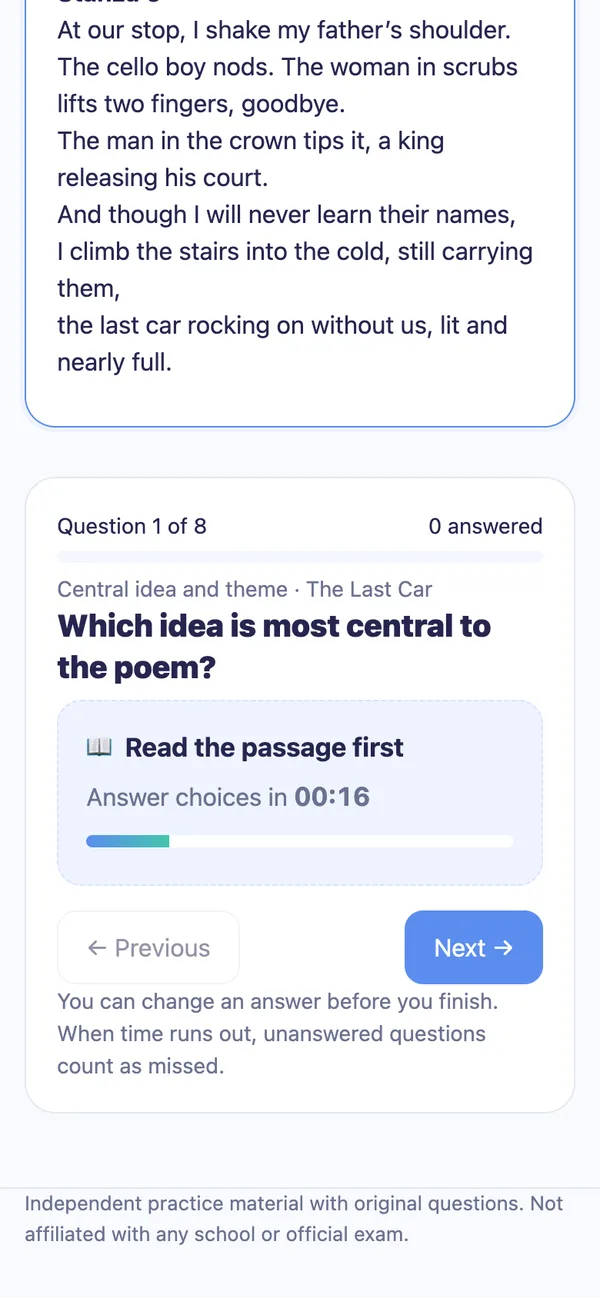
Start with the official tools. The NYC SHSAT Portal has a Student Readiness Tool tutorial that shows how the test interface works, plus four full online practice tests that mirror the real exam’s form and content, all in a regular web browser. Have your child take at least one under real timing, in one sitting. Between those, focus on accuracy and the no-going-back habit: short timed sets where your child commits to each answer and never returns to it, then a calm review together of what they missed and why. That is where MiloMint Learn can help. It is not computer-adaptive, and we will not pretend it is. What it does give you is a 300-question SHSAT Math bank (including 44 grid-in questions where your child types the number) and a 300-question ELA bank with reading passages, in timed full tests and topic practice. A “Read first” setting makes your child read the passage before the answer choices appear, and you can see progress and the exact questions they missed to revisit together.
Sources: NYC Public Schools, Specialized High School Admissions Test and Specialized High Schools, verified October 23, 2026. Details can change; check the official pages before test day. MiloMint is not affiliated with NYC Public Schools.
Frequently asked questions
Is the SHSAT computer-adaptive in 2026?
Yes. According to NYC Public Schools, beginning in fall 2026 the SHSAT is a computer-adaptive test. The system re-estimates each student’s score after every response and selects questions accordingly; correct answers can lead to harder questions and incorrect answers to easier ones.
How many questions are on the SHSAT?
100 in total: 50 in ELA and 50 in Math. Each subject includes 10 unscored field-test questions that are not identified on the test, so students should answer every question as if it counts.
How long is the SHSAT?
Standard testing time is 180 minutes for both sections together. English Language Learners and eligible former ELLs receive extended time totaling 360 minutes, with two 15-minute breaks after the first 180 minutes. Students with IEPs or 504 Plans receive their approved accommodations.
Can you go back to questions on the SHSAT?
Mostly no. In Math and on stand-alone ELA questions, students cannot return to a question after moving on. In passage-based ELA sets they can change answers within the set until they submit it. After a subject is submitted, none of its questions can be revisited.
Should my child take ELA or Math first on the SHSAT?
Students choose the order. There is no official recommendation; pick the order that keeps your child calm and focused, often starting with the stronger subject for momentum, and use the same order on the last few practice tests.
Is there an official SHSAT digital practice test?
Yes. The NYC SHSAT Portal offers a Student Readiness Tool tutorial and four fully functional online practice tests that mirror the real exam, available in a web browser. The NYC Guide to the SHSAT is also available as a PDF in 12 languages.
Does the adaptive SHSAT make the test easier for some kids?
Every student answers the same number of questions on the same standards, and scores account for the difficulty of the questions each student saw. Getting easier questions after early misses does not mean a better score; it is part of how the system estimates performance.
Build accuracy and the no-going-back habit
Timed SHSAT Math and ELA practice with reading passages, plus a parent view of every missed question to revisit together.
Open MiloMint Learn →SHSAT and Mark Twain practice tests on any computer · Part of Milo+ ($3.99/mo or $29.99/yr) · No ads
Keep reading: SHSAT cutoff scores for 2026, how the SHSAT is scored, or SHSAT 2026 test dates and registration. Or open MiloMint Learn.
Photos via Pexels: Kaboompics.