What's on the Mark Twain Science and Computer/Math Talent Tests
The Mark Twain Science and Computer/Math talent tests are each a paper-based exam of 50 multiple-choice questions, taken in person at I.S. 239 in Coney Island by NYC 5th graders applying for 6th grade. Science covers science skills, math, graphing, data analysis, observation, reading comprehension, logic and following procedures; Computer/Math covers number sense, patterns, loops and conditions, early algebra, geometry, data and probability, algorithms and basic debugging. Below are the official topic lists, three original practice questions for each test, and a calm six-week plan.

TL;DR: Both tests are paper-based, 50 multiple-choice questions, taken in person at Mark Twain (I.S. 239). Science rewards reading graphs, judging fair tests and following procedures. Computer/Math rewards number sense, patterns and tracing loops and if/else rules by hand; no programming language needed. Register by November 2, 2026. Twain does not publish the time limit or sample questions, so practice the listed topics, not a guessed format.
The Science talent test: format and topics
Mark Twain describes its Science Talent entrance exam as a traditional paper-based test of 50 multiple-choice questions. Notice how little of the topic list is memorized facts. Most of it is thinking like a scientist: reading a graph, spotting a pattern in data, deciding whether an experiment is fair, and following a written procedure step by step. Reading comprehension is on the list too, so a child who reads carefully and slowly through a passage about an experiment has a real edge. The school does not publish the time limit, so plan to practice at a steady pace rather than to a specific clock. If Science at Twain is your child's first choice, the school says to list it first on the application.
| Science topic (official list) | What it looks like for a 5th grader |
|---|---|
| Skills of science | Hypothesis, variables, measuring, recording results |
| Mathematics | Arithmetic, units, simple rates inside science questions |
| Graphing | Reading bar and line graphs, picking the right graph |
| Analysis | Finding the trend in a data table, predicting the next value |
| Observation | Noticing what changed and what stayed the same |
| Problem solving | Multi-step questions about a setup or experiment |
| Reading comprehension | Short science passages, answering from the text |
| Logic | Which conclusion the evidence actually supports |
| Following procedures | Doing steps in order, spotting a skipped step |
| Critical thinking | Is this a fair test? What would make it better? |

Three original Science practice questions
These are original practice questions we wrote in the style of the topics Twain lists (data tables, fair tests, drawing conclusions). They are not from Mark Twain or the DOE, and the real test may look different. Have your child answer before reading the explanation, then talk through the why together.
Original practice question in the style of the Mark Twain Science talent test.
Maya measured a bean plant every two days. Day 1: 2 cm. Day 3: 5 cm. Day 5: 8 cm. Day 7: 11 cm. If the plant keeps growing the same way, how tall will it be on Day 9?
A) 12 cmB) 13 cmC) 14 cmD) 16 cm
Answer: C) 14 cm. The plant grows 3 cm every two days, so 11 + 3 = 14.
Original practice question in the style of the Mark Twain Science talent test.
Maya wants to test whether salt water freezes more slowly than plain water. She puts one cup of each in the freezer. Which of these should be DIFFERENT between the two cups?
A) The amount of water in each cupB) Whether salt is addedC) The size of the cupsD) Where in the freezer the cups sit
Answer: B) Whether salt is added. In a fair test only one thing changes; everything else must stay the same.
Original practice question in the style of the Mark Twain Science talent test.
A toy car rolls 120 cm on a wooden floor, 80 cm on a rug, and 40 cm on thick carpet, pushed the same way each time. Which conclusion do these results best support?
A) Heavier cars roll fartherB) Rougher surfaces make the car stop soonerC) The car rolls faster on carpetD) Wood is heavier than carpet
Answer: B) Rougher surfaces make the car stop sooner. Only the surface changed, and distance dropped as the surface got rougher (more friction).
The Computer/Math talent test: format and topics
The Computer/Math Talent exam is also paper-based with 50 multiple-choice questions. Despite the name, children do not need to know a programming language. The coding topics are about computational thinking: following a loop by hand, tracing what an if/else rule does, finding the bug in a short set of instructions, and putting steps in the right order. The rest is strong 5th-grade math stretched a little further: number sense, patterns, early algebra, shapes and spatial reasoning, and simple probability, often wrapped in word problems. As with Science, Twain does not publish the time limit, and if Computer/Math is your first choice you list it first.
| Computer/Math topic (official list) | What it looks like for a 5th grader |
|---|---|
| Number sense | Place value, factors, fractions, estimating |
| Patterns and sequences | Finding the rule, the next term, the 10th term |
| Logical reasoning, loops, and conditions | Tracing repeat steps and if/else rules by hand |
| Word problems | Multi-step everyday problems |
| Early algebra | Missing numbers, simple equations, input/output tables |
| Geometry and spatial reasoning | Area, perimeter, turning and flipping shapes, grids |
| Data and probability | Reading tables, simple chance (“3 out of 10”) |
| Algorithms | Putting steps in the right order to reach a goal |
| Basic coding concepts and debugging | Finding the one wrong step in a set of instructions |
| Critical and computational thinking | Breaking a problem into smaller steps |
Three original Computer/Math practice questions
Again, these are original practice questions we wrote in the style of the listed topics (loops, patterns, conditions). They are not official samples. The best habit to build here is tracing: writing down the value after each step instead of doing it in your head.
Original practice question in the style of the Mark Twain Computer/Math talent test.
A program starts with x = 3. It runs this step 4 times: x = x × 2. What is x at the end?
A) 11B) 24C) 48D) 96
Answer: C) 48. 3 → 6 → 12 → 24 → 48; the loop doubles x four times.
Original practice question in the style of the Mark Twain Computer/Math talent test.
What number comes next? 2, 5, 11, 23, __
A) 35B) 46C) 47D) 49
Answer: C) 47. Each number is doubled, then 1 is added: 23 × 2 + 1 = 47.
Original practice question in the style of the Mark Twain Computer/Math talent test.
A program reads a number n. If n > 10 it prints BIG. Otherwise, if n > 5 it prints MEDIUM. Otherwise it prints SMALL. What does it print when n = 10?
A) BIGB) MEDIUMC) SMALLD) Nothing
Answer: B) MEDIUM. 10 is not greater than 10, so the first check fails; 10 > 5 is true, so it prints MEDIUM.
A six-week prep plan that fits a school year
Register by Monday, November 2, 2026, then count back six weeks from the testing date that appears in your child's MySchools account in late December (Twain has posted tentative January dates). Twenty to thirty minutes, four days a week, is plenty for a 10-year-old. MiloMint Learn has a Mark Twain section built for exactly this: a Science bank of 250 questions and a Computer Science bank of 300 questions, each with short lessons and a glossary, topic practice and timed full tests. Turn on “Read first” so your child reads the question before the answers appear, and use the parent view to see progress and the missed questions to revisit together. It is practice in the style of the topics, not an official test, and it is part of Milo+ ($3.99 a month or $29.99 a year).
| Week | Focus (20 to 30 minutes, 4 days a week) |
|---|---|
| Week 1 | One untimed mixed set per test to see where your child stands. Read the glossary terms they missed. |
| Week 2 | Science: graphs and data tables. Computer/Math: number sense and patterns. |
| Week 3 | Science: fair tests and following procedures. Computer/Math: loops and conditions, traced on paper. |
| Week 4 | Science: reading passages about experiments. Computer/Math: word problems, early algebra, geometry. |
| Week 5 | One timed full test per talent. Revisit every missed question together. |
| Week 6 | Light review of weak topics only, a second timed test, then rest before test day. |
For dates, the application steps and the other talents (Creative Writing, Drama, Dance and the portfolio programs), see our Mark Twain talent test 2026 guide. Planning further ahead? Read SHSAT 2026 dates and registration.
Sources: twain239.com Science Talent and Computer Mathematics Talent pages (twain239.com/apps/pages/index.jsp?uREC_ID=539676&type=d) and Mark Twain's How to Apply page; NYC Public Schools middle school auditions page (schools.nyc.gov). Verified October 23, 2026. Test length, seats per talent and applicants per seat are not published; check with the school for anything not listed here.
Frequently asked questions
What is on the Mark Twain Science talent test?
Mark Twain describes it as a paper-based exam of 50 multiple-choice questions covering skills of science, mathematics, graphing, analysis, observation, problem solving, reading comprehension, logic, following procedures and critical thinking.
What is on the Mark Twain Computer/Math talent test?
It is a paper-based exam of 50 multiple-choice questions covering number sense, patterns and sequences, logical reasoning with loops and conditions, word problems, early algebra, geometry and spatial reasoning, data and probability, algorithms, basic coding and debugging, and computational thinking.
Does my child need to know how to code for the Computer/Math test?
Mark Twain lists basic coding concepts and debugging, but no programming language. Practice tracing loops and if/else rules by hand on paper; that is the skill the topic list points to.
Is there an official Mark Twain test sample?
Mark Twain's talent pages list the topics but do not post sample questions. Any practice you find elsewhere, including the original questions in this article, is in the style of the topics, not the real test.
How long are the Mark Twain talent tests?
Mark Twain does not publish the time limit for the Science or Computer/Math test. Check with the school or your child's MySchools account for testing details.
When are the Mark Twain talent tests for 2027 entry?
The deadline to register to test is Monday, November 2, 2026. Testing dates appear in your child's MySchools account in late December; Twain has posted tentative dates of January 9, 10, 23, 24, 30 and 31, 2027. Offers are released April 7, 2027.
Can my child try both the Science and Computer/Math tests?
A student may list one or two talent programs. If one of them at Mark Twain is your first choice, the school says to list it first on the application.
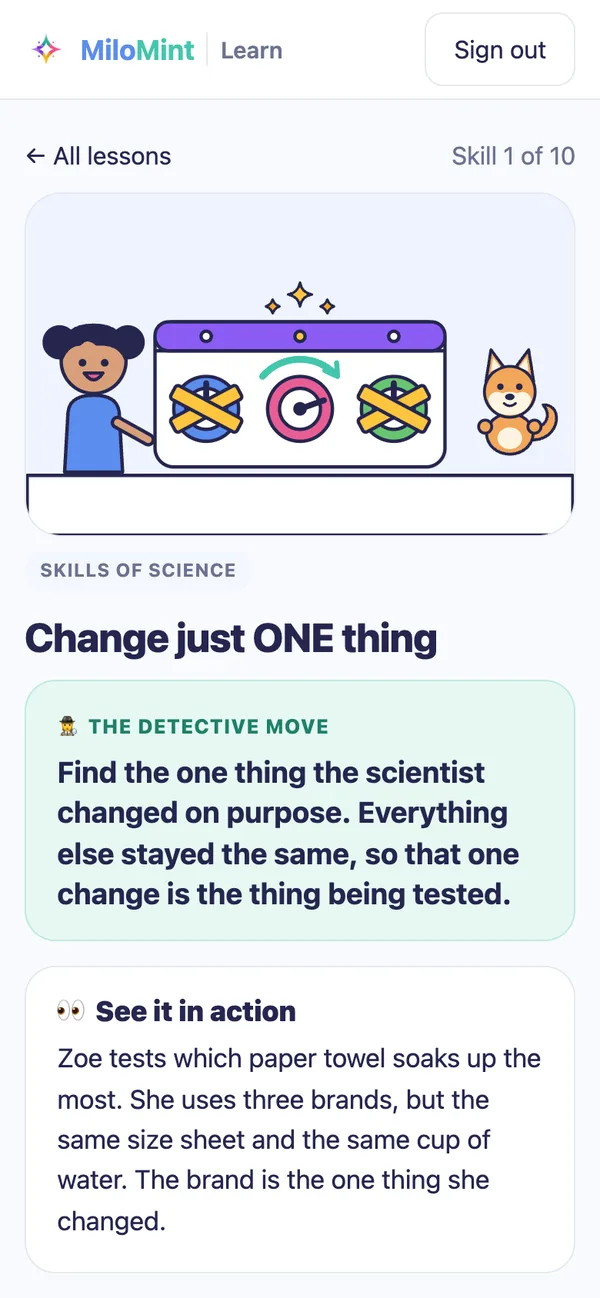
Mark Twain Science and Computer Science practice, at home
250 Science and 300 Computer Science questions with short lessons, a glossary, topic practice and timed tests. You see what to revisit.
Open MiloMint Learn →SHSAT and Mark Twain practice tests on any computer · Part of Milo+ ($3.99/mo or $29.99/yr) · No ads
Keep reading: MiloMint Learn, the 2026 computer-adaptive SHSAT, and how the SHSAT is scored.
Photos via Pexels: Yan Krukau, MART PRODUCTION.