MiloMint: a simple allowance tracker for kids, not real money
MiloMint is a simple allowance tracker for kids: it keeps a clear running total of what each child earns, spends, and saves, and nothing more. It is for parents who want allowance conversations to be clear and age-appropriate without putting real money into an app a child controls. Every child has a balance measured in your family's chosen currency, and that balance only changes through four kinds of entries: earnings from approved chores, bonuses you grant, deductions for missed work, and redemptions when a reward is cashed in. You set a weekly allowance amount, pick a reward time, and decide whether reward time runs automatically or waits for your tap. Because MiloMint never touches real money, you stay responsible for handing over any allowance in real life; the app simply keeps an honest, explainable running total everyone can see. MiloMint is free on the App Store, with Android coming soon.
MiloMint's ledger is intentionally small so a ten-year-old can read it. Every change to a balance is one of four kinds. An earning is created when you approve a paid chore, and it carries the chore's name so the history reads "Approved: Help with dishes, plus one dollar fifty." A bonus is a discretionary reward you add, like a two-dollar reading-streak bonus. A deduction subtracts value, most often the small missed-task penalty you configure per child. A redemption removes value when a reward is cashed in. Each entry is dated and labeled in plain language, so the wallet is not a mysterious number that goes up and down; it is a story of what actually happened. When a child asks why they have eighteen dollars and fifty cents, you can scroll and answer in seconds instead of relitigating the week from memory.
Weekly allowance, reward time, and autopay
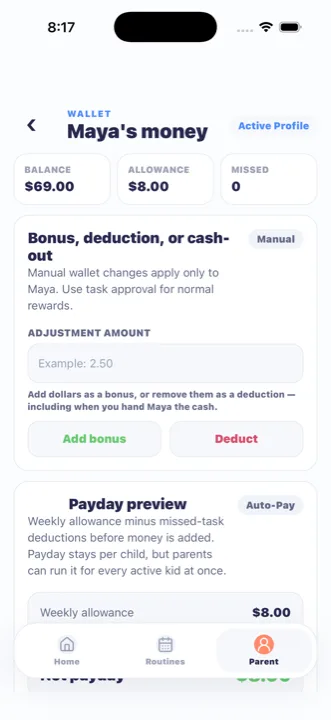
Each child has an allowance rule with a weekly amount, a reward time weekday, an autopay switch, and a missed-task deduction. You might set one child to five dollars paid on Saturday with autopay off, and another to eight dollars paid on Friday with autopay on. When autopay is on, reward time posts the weekly amount to that child's ledger automatically on the chosen day; when it is off, reward time waits in your review flow so you can confirm the week was actually earned before the balance updates. The missed-task deduction, for example fifty cents, gives you a gentle, consistent consequence that the ledger records rather than a lecture nobody remembers. Because these rules live per child, siblings can be on completely different allowance systems that match their ages and habits without you tracking any of it on paper. A six-year-old might get a tiny fixed amount with autopay on so the lesson is just "money arrives on Saturday," while a twelve-year-old runs a larger, partly earned allowance with autopay off so reward time becomes a real conversation about whether the week was actually held up. The settings flex with the child instead of forcing one family policy onto very different ages.
Goals turn saving into something visible
Allowance only teaches patience if there is something worth waiting for, so each child can set a goal with a target amount, such as a forty-dollar Lego set or a thirty-five-dollar art kit. MiloMint shows progress toward that goal next to the balance, which reframes "I have money" into "I am this far from the thing I want." Because earnings, bonuses, and deductions all feed the same balance, a child can watch a good week of approved chores close the gap and a splurge redemption push it back. This is deliberately a teaching tool, not a financial product: there is no interest, no real account, and no spending happening inside MiloMint. The goal exists to make the trade-off between spending now and saving for something bigger concrete and visible, which is the exact lesson a young allowance is supposed to deliver.
Why a simple tracker keeps allowance calm
For young kids, the calmest way to run allowance is to keep it simple. MiloMint deliberately keeps real money in your hands and only tracks the numbers, so there is no account to fund, nothing to lose, and no way for a balance in the app to turn into real spending without you. Kids still get the whole educational core — tracking, approval, the weekly reward time rhythm, and goals — while you stay in charge of anything real. For families who want their seven- or ten-year-old to learn earning and saving with training wheels on, a clear running total is the safer, calmer choice, and it is exactly what MiloMint is built to be. It also keeps a parent in the conversation: because you review the balance together, allowance stays a talk about why money was earned, lost, or saved, which is where the actual lesson lives at these ages.
How earning, the missed-task penalty, and reward time fit together
The reason MiloMint works as a teaching tool is that the whole week tells a consistent story. During the week, approving a paid chore adds an earning to the balance, and you can drop in a bonus for something exceptional. If a child blows off a scheduled task, the daily review marks it missed and the small per-child deduction you configured, often fifty cents, can be recorded, so consequences are proportional and predictable rather than dramatic. Then reward time lands on the weekday you chose and adds the base weekly allowance on top. By the weekend a child can look at the wallet and see the full arc: what they earned, what they lost, what they were given, and what the regular allowance added. Tying earnings, penalties, and reward time into one ledger is what lets a young child connect effort over a week to the number they end up with, instead of treating allowance as money that simply appears.
Frequently asked questions
Does MiloMint handle real money?
MiloMint does not handle real money. It simply tracks balances in your chosen currency — a clear running total, nothing more. Parents stay responsible for handing over any allowance in real life; MiloMint only records what was earned, spent, and saved.
How does allowance work in MiloMint?
MiloMint gives each child a weekly allowance amount, a reward time weekday, an autopay toggle, and a missed-task deduction. Earnings from approved chores, bonuses, deductions, and redemptions all feed one balance. Reward time posts automatically or waits for your approval, depending on the autopay setting you choose.
Can two kids have different allowance rules?
MiloMint stores allowance rules per child, so siblings can run completely different systems. One child might earn five dollars paid Saturday with autopay off, another eight dollars paid Friday with autopay on. You configure each child's amount, reward time, and deduction independently to match their age.
Is MiloMint free to use as an allowance tracker?
MiloMint is free to start tracking allowance, chores, and rewards for your family. There is no real-money funding step because nothing is a live account. We do not list further pricing here and will never charge real money to a child's profile.
Can my child spend their allowance inside the app?
No spending happens inside MiloMint. A child can request a reward, and once you approve it the cost is recorded as a redemption in the ledger. The actual money or treat is handled by you in the real world. MiloMint only keeps the running total clear.
Can I correct a mistake in the ledger?
MiloMint lets parents add bonuses and deductions directly, so you can correct or adjust a balance by recording a new entry with a clear label. Because every change is dated and named in plain language, the history stays honest and you and your child can always see what happened.