MiloMint: the kids chore app parents can actually keep up with
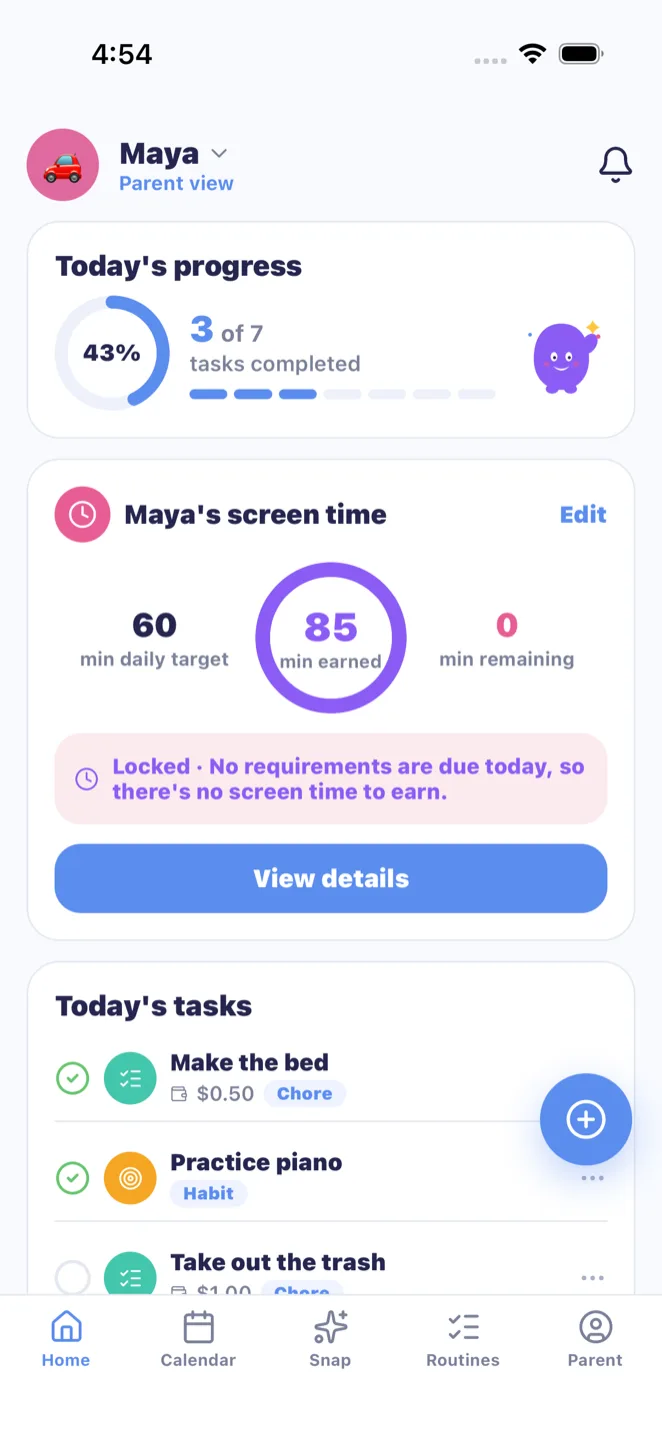
MiloMint is a kids chore app for families who are tired of rebuilding the same paper chart every week and chasing kids to remember what they owe. It is built for households with children roughly five to thirteen, where one or two parents want to assign chores, set them to repeat, and review finished work without nagging. Each chore carries a title, a short detail, a category, an optional reward, and a due date. Kids open a simple Today view, tap a task when it is done, and it moves into a single parent approval queue. Parents approve, send it back, or let it count toward allowance. Recurring jobs regenerate themselves on schedule, so nobody re-enters "make your bed" every morning. MiloMint is a free iOS app on the App Store, with Android coming soon, and it simply keeps track of what kids earn — you hand over any real allowance yourself.
When you assign a chore in MiloMint you give it a title like "Clean bedroom floor," a short detail ("Laundry in the hamper, books on the shelf, toys in bins"), a category, a due date, and an optional reward in your family's allowance currency. Categories matter because they change the language the app uses: a Chore can earn money, a Homework item is labeled required-for-school with no cash, and a Habit or Routine can build a streak without a payout. Reward amounts are intentionally small and concrete, such as one dollar seventy-five for the bedroom or one dollar for twenty minutes of reading, so the value of effort stays believable. You can spin chores up one at a time or use a starter pack like "School night reset" that drops in homework, backpack, and a ten-minute room reset together. Nothing leaves your control until you review it.
The Today view kids see
Children get a deliberately small view, not the full parent dashboard. Today shows what is ready to do now, what is waiting for a parent to approve, and what has already been approved. Tapping a finished task submits it; it does not mark itself paid or change any balance. That separation is the whole point. A seven-year-old can run their own morning without an adult standing over the phone, and a parent never wakes up to a child having quietly awarded themselves five dollars. Submitted work shows a clear waiting state so kids learn that "I did it" and "a grown-up checked it" are two different things. Because the kid view hides settings, allowance rules, and other children's data, handing a child the phone for two minutes is safe by design rather than by trust. The same view is where a child sees their balance, their goal progress, and how close they are to unlocking the day's screen time, so the one screen they own pulls together effort and reward in language a young reader can follow on their own.
Recurring chores that regenerate themselves
Most family work repeats, so MiloMint treats repetition as a first-class feature instead of asking you to copy tasks forward. A chore can recur daily, weekly on chosen weekdays, or on school days only (Monday through Friday). Each morning the app runs a quiet daily review: it materializes that day's recurring instances as fresh scheduled tasks, and it marks any past scheduled task that was never submitted as missed. So "feed the pet" daily, "sort laundry" every Saturday, and "pack backpack" on school days simply appear when they are due and disappear from the active list when the day passes. You set the rhythm once during setup and the calendar maintains itself. The same review also closes the loop on the past: a recurring chore that was scheduled but never submitted is marked missed, so the history shows what actually happened rather than a list of permanently open tasks. This is the difference between a chore chart you maintain and a chore app that maintains the chart for you, and it is usually the reason a family is still using MiloMint a month after they started instead of having quietly given up.
Categories keep money in its place
Not every responsibility should come with a price tag, and MiloMint is opinionated about that. The category you pick decides whether a task is about money or about character. Chores can earn allowance. Homework is framed as required for school with no payout, because being paid to do schoolwork is a message most parents do not want to send. Routine, Habit, and Family tasks, like brushing teeth, reading, or wiping the table after a meal, can build a streak and pride without a cash transaction. This lets you run an honest mixed system: a child can have a paid chore, a no-cost reading habit, and a required homework item all in the same Today list, each described in language that matches what it really is. The result is fewer arguments about why one thing pays and another does not, because the app is making the distinction visible instead of leaving it to a tired parent at the end of the day.
Built for more than one child, and for one calm parent
Families rarely have just one kid, and MiloMint is built for the household, not a single profile. Each child gets their own color, avatar, grade, balance, streak, goal, and allowance rule, so a fourth-grader and a fifth-grader can run side by side without their tasks or money mixing. A parent dashboard shows the whole family at a glance, including who has work waiting for approval, while each child's own login only ever shows their slice. Behind it all sits the daily review that quietly does the housekeeping: it brings forward today's recurring chores and flags yesterday's unfinished ones as missed, so you are never the one manually rolling the chart over. The design goal is a chore app that one busy parent can actually sustain past week three, when most paper charts and clever spreadsheets have already been abandoned on the counter.
Frequently asked questions
Is MiloMint free?
MiloMint is free to start as a family chore and allowance tracker. You can create your family, add children, assign recurring chores, and run the parent approval queue without paying. We do not publish other pricing details here and will never auto-charge real money to a child.
What ages is MiloMint for?
MiloMint suits children roughly five to thirteen. Younger kids use the simple tap-to-submit Today view and earn small rewards or streaks, while older kids manage weekly allowance, goals, and reward requests. Parents control every account, so the app scales down for early readers and up for tweens.
Is MiloMint safe and private for kids?
MiloMint is parent-controlled by design. Children sign in with a Kid Code and PIN to a limited view that hides settings, allowance rules, and siblings' data. Parents own the family account and all child profiles, so kid data stays parent-managed rather than independently held by the child.
How do kids submit chores without changing their balance?
MiloMint keeps doing and approving separate. A child taps a finished chore to submit it, which moves it into the parent review queue. Nothing affects allowance until a parent approves it. Kids cannot pay themselves, so the family ledger only changes when an adult signs off.
Can chores repeat automatically?
MiloMint supports daily, weekly, and school-day recurring chores. Each morning the app regenerates that day's due tasks and marks anything never submitted as missed. You set a chore's schedule once and MiloMint maintains the chart, so you stop re-entering the same tasks every week.
Is MiloMint on the App Store?
MiloMint is a free iOS app on the App Store, with Android coming soon. It covers chores, recurring routines, allowance ledger, rewards, and the parent approval queue, so you can set up your whole family in minutes.