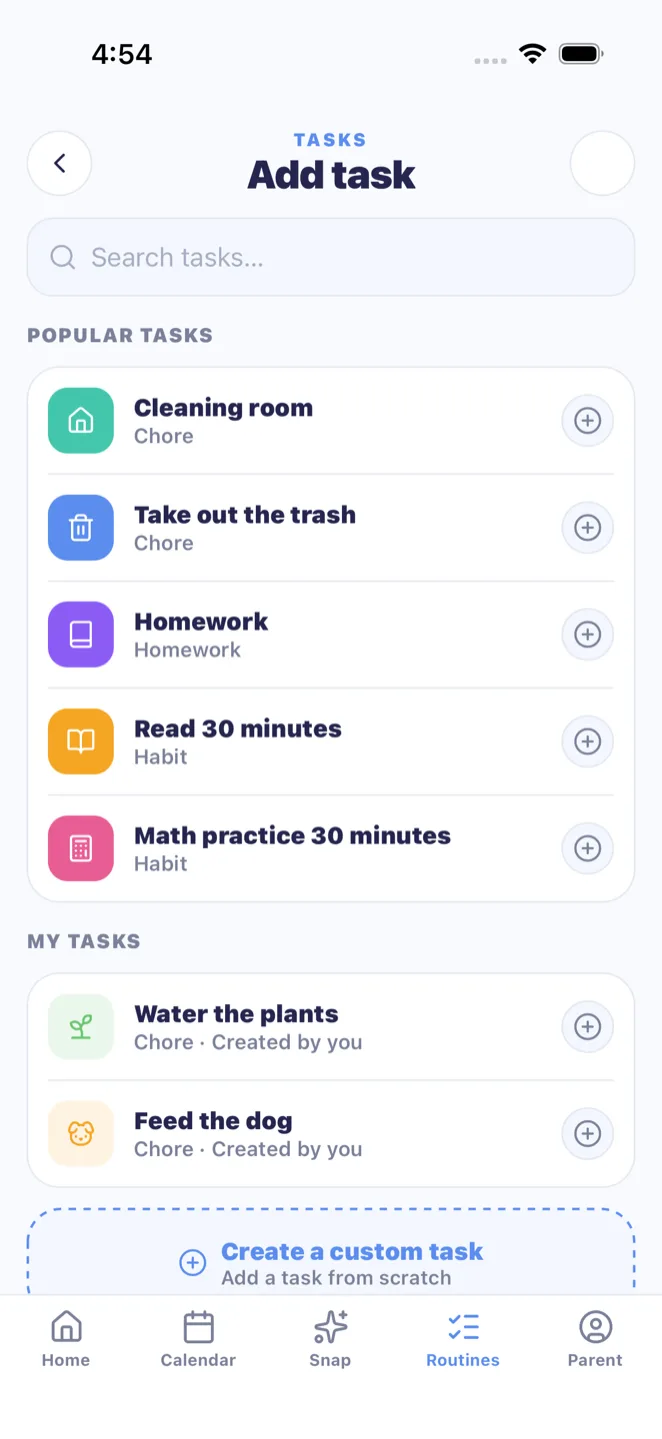
MiloMint: a family routine app for mornings, school days, and bedtime
MiloMint is a family routine app for parents who want predictable mornings, smooth school nights, and calm bedtimes without managing a corporate-style calendar for their kids. It is aimed at households with elementary and middle-school children who thrive on knowing exactly what comes next. Instead of one-off events, MiloMint is built around repeating routines: a task can run daily, weekly on specific weekdays, or on school days only. Each morning the app regenerates that day's routine items automatically, so the same expectations show up at the same time without anyone re-entering them. Routine tasks do not have to cost money, which means brushing teeth, packing a backpack, reading, or setting out tomorrow's clothes can build responsibility on their own. Kids see a short, action-focused list; parents see what is due today and what is coming next. MiloMint is free on the App Store, and Android is coming soon.
A routine in MiloMint is a task with a recurrence rule, and there are three rhythms that cover almost every family. Daily routines, like a ten-minute room reset or twenty minutes of reading, appear every single day. Weekly routines run on the weekdays you pick, so "sort laundry" can land every Saturday and "empty the recycling" every Wednesday. School-day routines run Monday through Friday only, which is perfect for backpack prep and homework folders that should rest on weekends. You define the rhythm once when you create the task, and MiloMint's daily review materializes that day's instances each morning. There is no copying tasks into next week and no calendar to babysit. The routine you described becomes a self-maintaining list, which is the entire reason a routine app should exist instead of a static checklist printed on the fridge.
Mornings, school nights, and bedtime as named blocks
Families do not think in single chores; they think in blocks of time. MiloMint supports starter packs that bundle routines so you can stand up a whole part of the day at once. A "School night reset" pack, for instance, drops in a homework folder task, a backpack-packing routine, and a ten-minute room reset, each pre-set to the right recurrence. You can adapt the pieces, but the heavy lifting of building an evening routine is done in a tap. This matches how routines actually fail in real life: it is never one missing chore, it is the whole evening collapsing because nobody knows the order. By giving the morning, the school night, and bedtime a consistent shape, MiloMint makes the sequence the child learns, so eventually the routine runs even when you are busy in another room. And because each piece keeps its own recurrence, you can adjust one part without breaking the rest, dropping the reading habit to weekends or moving backpack prep earlier, while the block as a whole keeps doing its job of telling the child what comes next.
A calm kid view versus the parent's week
Routines only stick if the child can follow them without an adult narrating every step, so MiloMint gives kids a stripped-down Today view focused on action: what to do now, what is waiting on a parent, what is done. Parents get a wider lens that shows what is due today and what is coming next across the family, plus a calendar that can hold school events, appointments, and family reminders alongside the routines. The two views are generated from the same data, so they never disagree. A child checking their list and a parent glancing at the week are looking at one truth described two ways. This is what keeps a routine app from turning into yet another shared calendar that only the most organized parent ever opens; the kid owns their part, the parent sees the whole. The parent lens also rolls up multiple children at once, so on a school morning you can tell at a glance that one kid is on track and another still has a routine open, without opening anyone's individual view or interrogating them across the kitchen.
Responsibility without turning everything into money
The biggest trap in routine apps is making every habit a paid transaction, which quietly teaches kids that good behavior only happens for cash. MiloMint avoids this by letting routine, habit, and family tasks carry no reward at all. A streak counter rewards consistency on things like reading, so a six-day reading streak becomes its own source of pride. Brushing teeth, making the bed, and setting out clothes can be expected parts of the day rather than negotiations. When you do want to attach a small reward, you can, but the default posture is that routines build character and chores can build allowance, and the two are not the same thing. This keeps the family routine honest: the things a person simply does to be part of a household stay separate from the things that earn money.
When a routine slips, and how the day rolls over
Routines are only useful if the app handles the messy parts of real life, especially the days a routine does not happen. MiloMint runs a quiet daily review every morning that does two jobs at once. First, it materializes the day's recurring routines as fresh tasks so they appear exactly when due. Second, it looks back and marks any scheduled routine that was never done as missed, giving you an honest record without a confrontation at bedtime. That missed status is not just bookkeeping; in MiloMint it can feed the screen-time gate, so a child who skips their morning routine feels a natural, consistent consequence rather than a lecture. The rollover happens automatically, so you never start a day by manually clearing yesterday or re-adding tomorrow. The routine you designed simply keeps running, and the record of how the week actually went writes itself. That record is also genuinely useful on a Sunday: instead of guessing whether mornings improved, you can see which routines a child held all week and which ones kept slipping, and adjust the plan, an earlier bedtime task, a smaller list, a moved reading slot, based on what really happened rather than on the last argument you remember.
Frequently asked questions
How is MiloMint different from a shared family calendar?
MiloMint is built around repeating kid routines, not adult events. Daily, weekly, and school-day tasks regenerate themselves each morning and give children a simple action list. It includes a light calendar for school events and reminders, but its core job is running routines, not managing meetings.
Can routines run only on school days?
MiloMint supports school-day routines that run Monday through Friday only, so backpack prep and homework folders rest on weekends. You can also choose daily routines or weekly routines on specific weekdays. The app regenerates each day's due routines automatically based on the rhythm you set.
Do routines have to give a reward?
Routines do not need a reward in MiloMint. Habit, routine, and family tasks can carry no money at all and instead build a streak. This lets brushing teeth, reading, and bedtime prep be expected parts of the day rather than paid transactions, keeping character separate from cash.
What ages does a routine app like MiloMint suit?
MiloMint fits children roughly five to thirteen. Early readers follow the simple Today view and learn the sequence of a morning or bedtime, while older kids manage school-day routines and weekly chores. Parents set every routine, so it works across a range of ages at once.
Will I have to rebuild routines every week?
No. MiloMint maintains routines for you. Once a task has a recurrence rule, the app's daily review materializes that day's instances each morning and marks anything never done as missed. You define the rhythm once, so the routine list stays current without weekly rebuilding.
Is MiloMint available on iOS?
MiloMint is a free iOS app on the App Store, with Android coming soon. The web app already supports daily, weekly, and school-day routines, starter routine packs, the kid Today view, and the parent week view, so you can begin before iOS launches.