MiloMint: a homework and chore tracker that keeps schoolwork unpaid
MiloMint is a homework and chore tracker built on a clear principle: schoolwork is required, not paid, and chores can earn allowance, and a child should be able to see both in one place without the two getting confused. It is for parents of school-age kids who want homework tracked alongside household jobs but refuse to turn studying into a cash transaction. In MiloMint, a Homework task is labeled required-for-school and carries no reward, so the child reads it as an expectation rather than a paycheck. A Chore can carry a small reward and feed allowance. Both appear in the same Today list and both can flow into one parent review queue when finished. This means a fifth-grader can finish a math worksheet, pack their bag, and clean their room in one sequence, while the app keeps the message about each one honest. MiloMint is free on the App Store; Android is coming soon.
When you create a Homework task in MiloMint, the app frames it differently from a paid chore. It shows up with a required-for-school label and no earn wording, because the category itself sets the tone. A task like "Finish math worksheet, complete pages 42 and 43 before dinner" reads as a non-negotiable part of being a student, not as a way to make a dollar. This is a deliberate stance: research and plenty of parents agree that paying children for grades or schoolwork can undermine the intrinsic reason to learn. MiloMint encodes that belief into the product so you do not have to police it manually. The child still gets the clarity of seeing homework on the same list as everything else, with the same satisfying tap-to-submit flow, but the reward column simply is not part of the conversation for schoolwork.
Chores can earn, and you decide which ones
On the other side of the line, chores are where allowance lives, and MiloMint puts you in charge of which jobs are worth money. You might decide that cleaning the bedroom floor is worth a dollar seventy-five while wiping the table after dinner is just part of being in the family and earns nothing. Both can sit in the same list as the math worksheet. This lets you run a realistic mixed economy at home: some work is paid, some is expected, and homework is required. Because the reward is set per task, you can tune the values so they feel fair, keeping paid chores modest enough that allowance stays a teaching tool rather than a salary. The child learns to read the difference at a glance, which is a more useful life lesson than a flat "do everything for cash" system. Over time this also keeps allowance affordable for the parent: because only a handful of jobs carry a reward and the amounts are small, the weekly total stays sane, and you are never cornered into paying for things, like clearing a plate, that should simply be part of belonging to the household.
One list, one review habit
The reason to track homework and chores in the same app is that families do not split their evenings into a "schoolwork app" and a "chores app." In MiloMint, a child's Today view holds the math worksheet, the backpack-packing routine, and the room reset together, and each is submitted the same way. When the child taps done, the item flows into a single parent approval queue regardless of whether it was homework, a routine, or a paid chore. That gives parents one consistent review habit instead of checking three places. You can approve a finished worksheet, send back a half-done room with a note, and approve a chore for allowance in the same sitting. The unified queue is what makes the system sustainable, because the failure mode of most chore and homework trackers is that reviewing becomes its own chore the parent abandons. Keeping homework and chores in one queue rather than two apps also means you are not the bottleneck twice; you do one pass at the end of the day, decisions post to the right place automatically, and the child gets a single, consistent answer about what counted and what needs another try.
Required work still shapes the day
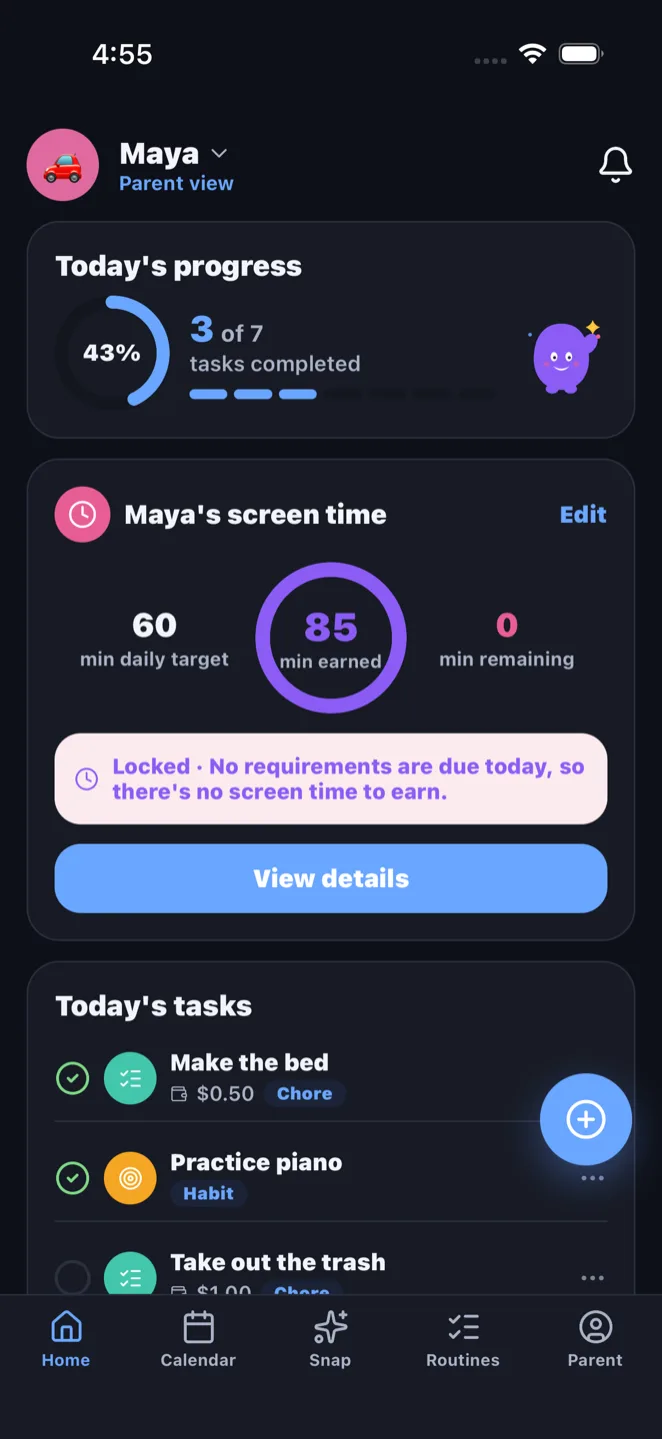
Even though homework earns nothing, MiloMint does not treat it as optional background noise. Required tasks count toward the family's expectations for the day, and in MiloMint's screen-time system they sit alongside chores as part of "today's requirements" a child must finish. So an unpaid math worksheet can still be the thing standing between a kid and their earned screen time, which is often a far stronger motivator than money for a ten-year-old. Missed homework, like any scheduled task that is never submitted, gets marked missed during the daily review, giving you an honest record without a confrontation. This is the balance MiloMint aims for: schoolwork is never cheapened into a paid gig, but it still carries real weight in the day, because it unlocks privileges and shows up in the family's shared picture of who did what.
School-day scheduling that respects the calendar
Homework follows the school week, so MiloMint lets you mark homework and school-prep tasks as school-day recurring, meaning they run Monday through Friday and rest on weekends automatically. A nightly homework folder check or a daily reading log can repeat exactly when school is in session without cluttering Saturday. The app also keeps a light calendar for the things around schoolwork that are not tasks, like a science-fair prep evening or a project due date, so the bigger picture lives next to the daily list. You can assign these to specific children, so a fifth-grader's science fair shows on her timeline and not her sibling's. The point is to fit how school actually works: required tasks repeat on the days they should, one-off school events get their own place, and a child opens their list to find exactly what tonight asks of them, no more and no less.
Frequently asked questions
Does MiloMint pay kids for homework?
No. MiloMint labels homework as required-for-school with no reward, deliberately keeping schoolwork unpaid. Homework appears in the same Today list as chores and uses the same tap-to-submit flow, but the earn wording is removed so studying reads as an expectation rather than a paycheck.
Can homework and chores live in the same app?
MiloMint tracks homework and chores together in one Today list and one parent review queue. A child can finish a worksheet, pack a bag, and clean a room in sequence, and every item flows to the same approval queue, so parents have one review habit instead of several apps.
How do I decide which chores earn money?
In MiloMint you set a reward per task, so you choose which chores pay and which are simply expected. You might pay a dollar seventy-five for cleaning a room while wiping the table earns nothing. Homework, by category, never carries a reward at all.
What happens if homework is not done?
MiloMint marks any scheduled task never submitted, including homework, as missed during its daily review, giving you an honest record. Required work also counts toward the day's screen-time requirements, so unfinished homework can keep earned screen time locked, often a stronger motivator than money.
What ages is the homework and chore tracker for?
MiloMint fits school-age children roughly five to thirteen. Younger kids track simple homework and routines, while older students juggle worksheets, projects, and paid chores in one list. Parents create and review every task, so the tracker adapts as a child moves through grade levels.
Is MiloMint on iOS yet?
MiloMint is available free on the App Store today, with Android coming soon. The web app already supports homework labeling, paid and unpaid chores, the unified parent review queue, and recurring school-day tasks, so you can start tracking before the iOS app ships.